Release Radar
AI-assisted backlog refinement and PI planning for Azure DevOps. It shows what's blocked, who owes the answer, and whether ADO actually got updated.
Problem
Refinement follow-ups slipped between meetings. Questions sat unanswered, owners were unclear, and ADO never got updated.
My role
Product owner and architect. Requirements, mockups, the security model, field mapping and test acceptance.
Built with
Azure DevOps REST API (read-only), AES-256-GCM, Claude for AI drafts. Code written with an AI coding assistant.
Outcome
About 3 workdays on its first release.
60-second demo with sample data, narrated in my own voice using Apple Personal Voice.
From reactive to proactive.
Before Release Radar, we were always reactive: following up after the fact instead of getting ahead of the release.
On the first release I ran through it, the release communication was already sent, the stakeholder review file was already out, and planning for the next release had already started. That's about 24 hours of work, roughly three workdays, back on the calendar.
Key decisions
Read-only, enforced twice
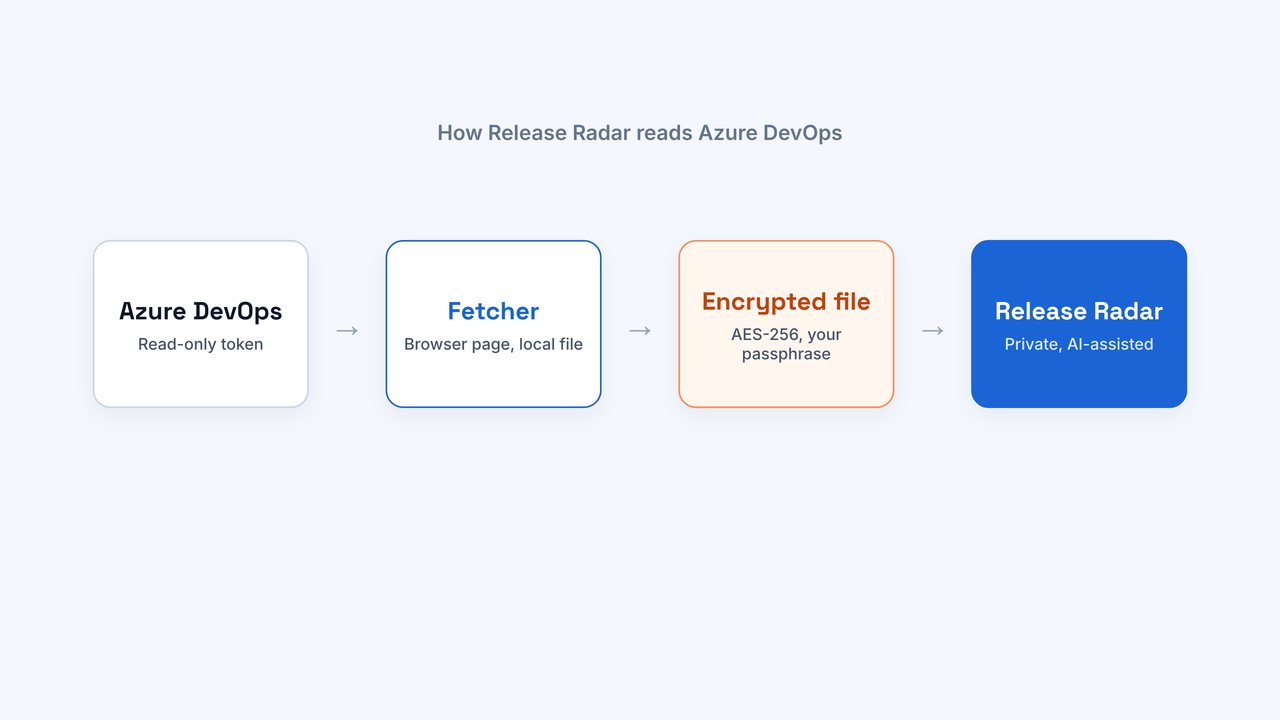
Why: Company AI rules don't allow AI to write to ADO. The token can only read, and no code path writes, so even a bug can't change a ticket.
Trade-off: ADO updates stay manual. So the app builds a to-do list and checks on the next pull whether each step really happened.
Encrypt everything that's saved
Why: AES-256-GCM with a key from my passphrase (600,000 PBKDF2 rounds). A lost laptop or fetcher file is useless to anyone else.
Trade-off: A passphrase every session and an auto-lock when idle. Worth it for backlog data.
Never store raw ticket text
Why: Descriptions and comments live in memory only while the AI drafts. If nothing sensitive is saved, nothing sensitive can leak.
Trade-off: A new AI draft needs a fresh pull from ADO.
A browser fetcher instead of an IT request
Why: Hosted pages can't reach ADO, and Microsoft's connector needed an IT app registration with a months-long wait. A local browser page reads ADO and hands off an encrypted file.
Trade-off: One extra step each pull. No installs, no servers, no ticket.
Also: private notes steer the AI
My notes help the AI explain why an item matters, but they never appear in anything stakeholders see. Ticket and spreadsheet text is fenced off as information, so the AI never treats it as instructions.
What I'd do next
- Write-back to ADO behind an off-by-default switch, a separate token and a review screen, if company AI rules change.
- Trend reporting: how long items wait for answers, and response times by owner.
- A sizing helper that suggests points from similar past items, once enough are sized.
Read the video transcript
Backlog refinement follow-ups slip between meetings. Questions go unanswered, nobody knows who owes the answer, and Azure DevOps never gets updated. I built Release Radar to close that loop. It pulls each item's details and comments from ADO, and AI checks it against the Definition of Ready: why it matters, and what's missing before sizing. Stakeholders answer in a shared Excel file. Their answers become an ADO to-do list, and the next pull checks that each step actually happened. It's read-only twice, by token and by code, so even a bug can't write to ADO. Everything saved is AES-256 encrypted, so a lost laptop or file is useless. Hosted pages can't reach ADO, and the official connector meant a months-long IT wait. So a browser fetcher hands off an encrypted file instead. No installs, no IT request. I designed it and decided what it's allowed to do. An AI coding assistant wrote the code.